Substance use disorders (SUDs) affected approximately 20.3 million people in 2018. Although 75% of these people are part of the workforce, most employers are unaware of the hidden costs associated with these illnesses. Workplaces bear significant costs due to absenteeism, increased healthcare expenses, turnover, and lost productivity.
Mon. - Fri. 8am - 5pm

- Behavioral Health
- Environmental
- Health Topics
- Clinical Services
- Resources
- Permits & Records
- About
Eng
Es
It
Sp
Recovery Friendly Workplace
Regulations created by the executive branch agencies
What is a Recovery-Supportive Workplace?
A recovery-supportive workplace aims to prevent exposure to workplace factors that could cause or perpetuate a substance use disorder while lowering barriers to seeking care, receiving care, and maintaining recovery. A recovery-supportive workplace educates its management team and workers on issues surrounding substance use disorders to reduce the all-too-common stigma around this challenge.
Maryland’s Recovery Friendly Workplace Model
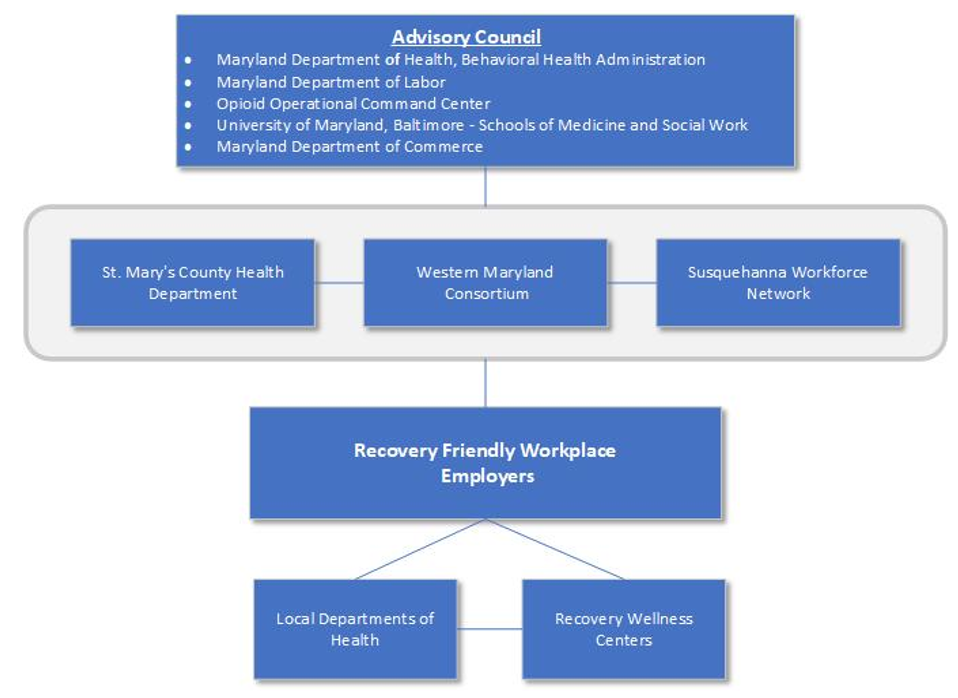
Maryland Department of Labor’s (MD Labor) RFW pilot is based on national models but is tailored to meet the needs of our state. The project is inclusive of four levels of stakeholders:
- An Advisory Council, which oversees the project. The Advisory Council includes:
- The Maryland Department of Health’s Behavioral Health Administration,
- Maryland Department of Labor,
- Maryland’s Office of Overdose Response,
- The Maryland Department of Commerce; and,
- representatives from The University of Maryland Schools of Medicine and Social Work;
- The sub-awardees:
- Western Maryland Consortium,
- Susquehanna Workforce Network; and,
- St. Mary’s County Department of Health.
- Employers participating in the RFW model
- Entities supporting RFW employers, including, but not limited to:
- Local Departments of Health; and
- Recovery Wellness Centers.
How Do Employers Benefit From Becoming Recovery Friendly Workplaces?
The Good News: Workers in recovery have lower turnover rates and are less likely to miss work days, less likely to be hospitalized, and have fewer doctor visits.
The National Safety Council has collaborated with an independent research institution at the University of Chicago to update “The Real Cost of Substance Use to Employers” tool, originally developed in 2017 with national nonprofit Shatterproof. This cost calculator is an authoritative, easy-to-use tool providing business leaders with specific information about the cost of substance use in their workplace based on the size of the employee base, industry, and state.
How Can Employers Reduce the Cost of Substance Use?
The first step to reducing these costs is awareness. The next step is to learn how to deal with the problem in a way that fosters a caring and supportive corporate culture while protecting your company and its most valuable asset – the employees.
- Watch this free webinar to find out how substance use is affecting your workforce and the steps you can take to begin addressing it
Workplaces are a critical point of contact for Americans struggling with or recovering from a substance use disorder. Ideally, workplaces will provide individual, family, and community support and improve the well-being of workers. Workplaces should create work environments that proactively prevent substance use, reduce stigma, and encourage treatment and sustained recovery.
Becoming a Recovery Friendly Workplace
Maryland’s Recovery Friendly Workplace (RFW) pilot utilizes a “tiered” approach for employers. This structure allows employers to engage with the RFW model at a pace that fits within their current capacity.
To participate, employers must, at a minimum, commit to completing a brief online survey and connecting with our local Recovery Friendly Advisor. From there, employers may commit to participating in activities in one of four tiers. Depending on which tier a participating employer begins their work, they are able to advance forward through the tiers as capacity and interest allow.
The key activity areas are:
- Updating/creating policies and/or practices addressing hiring, retention, and support of employees with an opioid or other substance use disorder;
- Stigma-reducing education programming for the workplace;
- Participation in research/data collection efforts related to Recovery Friendly Workplaces, such as completion of a more extensive survey evaluation; and,
- Providing naloxone training for employees and having naloxone present in the workplace.
View the RFW Activities Area Guide for each area.
The tiers are as follows:
- Platinum – Completing a brief online survey, connecting with a Recovery Friendly Advisor, and committing to adopting at least three key program activities;
- Gold – Completing the brief online survey, connecting with a Recovery Friendly Advisor, and committing to adopting two key program activities;
- Silver – Completing the brief online survey, connecting with a Recovery Friendly Advisor, and committing to adopting one key program activity; and,
- Bronze – Completing the brief online survey and connecting with a Recovery Friendly Advisor.
Getting Started
If you are ready to learn more about Recovery Friendly Workplaces and how you can participate, please send an email to: malik.mines@maryland.gov.
Recovery Friendly Workplace-Designated Businesses
The following local businesses have completed the required steps to obtain designation as a Recovery Friendly Workplace in Maryland.
Designated Businesses
- A Village Wellness Center
- Alpas Wellness
- Beacon Of Hope
- Charles County Freedom Landing
- Community Mediation of St. Mary’s County
- Good Shepherd Ministries
- K&I Healthcare Services
- Pyramid Healthcare
- Southern Maryland Jobsource
- St. Mary’s County Health Department
- St. Mary’s County Department of Human Services and Department of Social Services
- St. Mary’s County Library
- The Freedom Center
- The Jude House
- The Trend Thrift Store
- Three Oaks Center
5 Steps to Creating a Supportive Workplace
There are many ways that business leaders in St. Mary’s County can cultivate a supportive workplace. The following five key steps can help to mitigate the risk factors for initiation or perpetuation of a substance use disorder, help maximize the likelihood that employees in need will seek treatment, and support employees in their recovery efforts:
Written Policies & Operations
Workplace policies regarding substance use should be clear and transparent, defining the reasons for the policy, the prohibited substances and behaviors, the persons covered by the policy, and disciplinary consequences and appeals.
Workplace substance use policies should be sensitive to the nature of recovery efforts. For example, a recovery-supportive policy will recognize that recovery may involve one or more recurrences and, therefore, additional or modified treatment. Also, because employment increases the likelihood of entering treatment and maintaining recovery efforts, workplace policies should support recovering individuals attempting to maintain employment and those hoping to enter or return to the workforce.
Basic Elements of an Effective Policy
A drug-free workplace policy can include a statement of purpose and a discussion of implementation approaches. The other main elements of an effective policy are:
- Goals
- Definitions, Expectations, & Prohibitions
- Dissemination Strategies
- Benefits and Assurances
- Consequences and Appeals
Employee Education
Education covers types of drugs (including alcohol), the health impacts of using them, how substance use can impact behavior and performance at work, and workplace policies involving substance use.
- Workplace Prevention Basics provides an interactive guide for you to identify and prevent substance misuse in the workplace
- Provide general health promotion information on topics such as stress management, healthful eating, and fitness
Reduce Stigma
Individuals with a substance use disorder experience extreme levels of stigmatization (negative attitudes and stereotypes) that lead to prejudice, discrimination, social exclusion, and limited opportunities to participate fully in employment and other life roles. Stigmatization is also experienced by individuals who have recovered from a substance use disorder. Therefore, visible educational materials, as well as consistent discussions of the actual nature of substance use disorders, treatment, and recovery, may help reduce stigma and encourage entry into treatment and recovery. A key talking point in these materials and discussions is that a substance use disorder is not a moral failing, and recovery is possible.
Recommendations for Reducing Stigma In Workplaces
- Provide training to managers and workers to overcome misunderstanding and bias against individuals with substance use disorder
- Adopt health-promoting policies in the workplace to raise awareness and support workers and their family members struggling with a substance use disorder
- Eliminate imprecise and pejorative terms from workplace language and instead adopt language that reflects a health perspective and is consistent with terms used to describe other health conditions (e.g., “person with substance use disorder”)
- Ensure that all substance use policies are informed by science and supported by data
Training
Supervisor Training
Supervisors should receive training on how to recognize and deal with employees who have job performance and personal and family problems that could be related to alcohol or other drugs.
Prepare for Overdose Emergencies
An overdose can happen anywhere, including the workplace. Unintentional overdose deaths at work from non-medical use of drugs or alcohol increased for the seventh year in a row in 2019. Based on a survey conducted by the National Safety Council, 75% of employers report that opioid use has impacted their workplace, with 31% reporting an overdose, arrest, near miss or injury due to opioid use. Without immediate intervention, an opioid overdose can quickly lead to death. Naloxone is a medication that can reverse an opioid overdose.
Overdose Response Training & Naloxone
The St. Mary’s County Health Department offers free training for community members on:
- How opioids impact the brain and body
- How to recognize the signs and symptoms of opioid overdose
- How to administer naloxone
- How to care for someone who is having an overdose until emergency help arrives
Learn more and register for the training at smchd.org/overdose.
Naloxone
Naloxone (Narcan®) is a life-saving medication that may be able to restore the breathing of a person who has overdosed on opioids (e.g., heroin, fentanyl, oxycodone, hydrocodone, morphine, methadone, etc.) A variety of naloxone products, including a nasal spray, injection, and auto-injection, are available to respond to an overdose. Consider establishing a naloxone program in your workplace.
Using Naloxone in the workplace
Support Wellness
Make Help Accessible
- Provide prevention education and promote overall wellness: Health and wellness topics such as stress management, nutrition and weight management, physical activity and exercise, and pain management are great opportunities to provide educational materials and other information on substance misuse prevention. The training topics can be tailored to the needs and interests of your specific workplace.
- Providing support through an employee assistance program (EAP) or other means will help your drug-free workplace program succeed.
- Making the Business Case for Total Worker Health
Additional Actions
Workplaces can also take additional actions to help sustain the drug-free workplace, such as:
- Creating a Wellness Committee
- Hosting alcohol-free events to emphasize the organization’s commitment to preventing injuries and deaths associated with drinking and driving, especially around the holidays
- Sponsoring or supporting prevention services in your community that would benefit your employees and their families
- Sharing healthy lifestyle articles in your organization’s newsletter
Additional Resources
General Office Hours:
Mon – Fri: 8:00 am – 5:00 pm
Vital Records Processing Hours:
Mon – Fri: 8:30 am – 4:00 pm
Environmental Health Hours:
Mon & Thurs: 7:00 am – 2:00 pm
Tues, Wed, & Fri: 7:00 am – 4:30 pm
News & Updates
Enter your email to subscribe to the SMCHD newsletter and receive notifications of new health-related information.