Mon. - Fri. 8am - 5pm

- Behavioral Health
- Environmental
- Health Topics
- Clinical Services
- Resources
- Permits & Records
- About
Eng
Es
It
Sp
COVID-19
Prevention, symptoms, and treatment of the COVID-19 virus
Prevention, Symptoms & Treatment
Learn about COVID-19 prevention, symptoms, testing, vaccinations, and treatments

COVID-19 most often causes respiratory symptoms that can feel much like a cold, the flu, or pneumonia. COVID-19 may attack more than your lungs and respiratory system, though. Other parts of your body may also be affected by the infection. Most people with COVID-19 have mild symptoms, but some people become severely ill. Some people, including those with minor or no symptoms, can develop Post-COVID Conditions – also called “Long COVID.”
How COVID-19 Spreads
COVID-19 spreads when an infected person breathes out droplets and very small particles that contain the virus. Other people can breathe in these droplets and particles, or they can land on others’ eyes, nose, or mouth. In some circumstances, these droplets may contaminate the surfaces they touch. Anyone infected with COVID-19 can spread it, even if they do NOT have symptoms.
Prevention
- Get vaccinated and stay up to date on your COVID-19 vaccines
- Wash your hands often with soap and water or hand sanitizer
- Avoid close contact with people who are sick (or others if you are sick)
- Improve air ventilation when you are indoors
- Stay home when you are sick until your symptoms are improving and you are fever-free for 24 hours (without the use of medications)
- Wearing effective, fitted masks (such as KN95 masks or N95 masks) could help prevent exposure to the COVID-19 virus
Symptoms
Symptoms may change with new COVID-19 variants and can vary depending on vaccination status. Possible symptoms include:
- Coughing
- Shortness of breath
- Fever
- Chills and shaking
- Fatigue
- Muscle pain
- Headache
- Sore throat
- Congestion or runny nose
- New loss of taste or smell
- Diarrhea
- Vomiting
- Conjunctivitis
Feeling Sick?
Stay home and away from others (including people you live with who are not sick) if you have symptoms that aren’t better explained by another cause.
Seek health care promptly for testing and/or treatment if you have risk factors for severe illness. Treatment may help lower your risk of severe illness.
Testing
If you are experiencing any symptoms of COVID-19, wear a more effective mask and get tested within 24 hours.
OR
If you are not showing symptoms (asymptomatic) but may have been exposed to COVID-19, testing is recommended 4-6 days after exposure, even if you are fully vaccinated.
In-Person Rapid PCR Testing
- Rapid PCR tests are point-of-care tests (not take-home antigen tests). A healthcare professional takes the test and processes it on lab equipment that gives results within 30 minutes. PCR testing for COVID-19 is generally considered to be more accurate than antigen testing.
- SMCHD Testing Locations, by appointment only:
- School-Based Health Centers (SBHC)
- Margaret Brent Middle School SBHC: 29675 Point Lookout Rd, Mechanicsville
- Call (240) 434-6060 for an appointment
- Spring Ridge Middle School SBHC: 19856 Three Notch Rd, Lexington Park
- Call (240) 434-6059 for an appointment
- Hours: Monday – Friday 8:00 a.m – 4:00 p.m, by appointment only
- Margaret Brent Middle School SBHC: 29675 Point Lookout Rd, Mechanicsville
- School-Based Health Centers (SBHC)
- Results: Available online via the SMCHD CureMD patient portal
At-Home Rapid Antigen Test Kits
- Free at-home rapid antigen test kits are available while supplies last for St. Mary’s County residents:
- No appointment required – Pick up at:
- Health Hub at 21625 Great Mills Rd in Lexington Park (Drive-thru)
- Hours: 8:00 a.m. – 5:00 p.m.
- St. Mary’s County Health Department at 21580 Peabody Street in Leonardtown (Front Desk)
- Hours: 8:00 a.m. – 5:00 p.m.
- Health Hub at 21625 Great Mills Rd in Lexington Park (Drive-thru)
- Limitations: Two tests per person present, as supply allows
- No appointment required – Pick up at:
- Test kits are also available at all St. Mary’s County Library locations, while supplies last.
- Test kits are available for purchase at most pharmacies
COVID-19 Vaccine
Staying up-to-date with COVID-19 vaccination is effective in decreasing the risk of serious COVID-19 illness and reducing the spread of COVID-19 in a community. Medical societies, including the American Academy of Pediatrics, American Academy of Family Physicians, and the American College of Obstetricians and Gynecologists, have shared updated clinical recommendations for the 2025-2026 respiratory virus season.
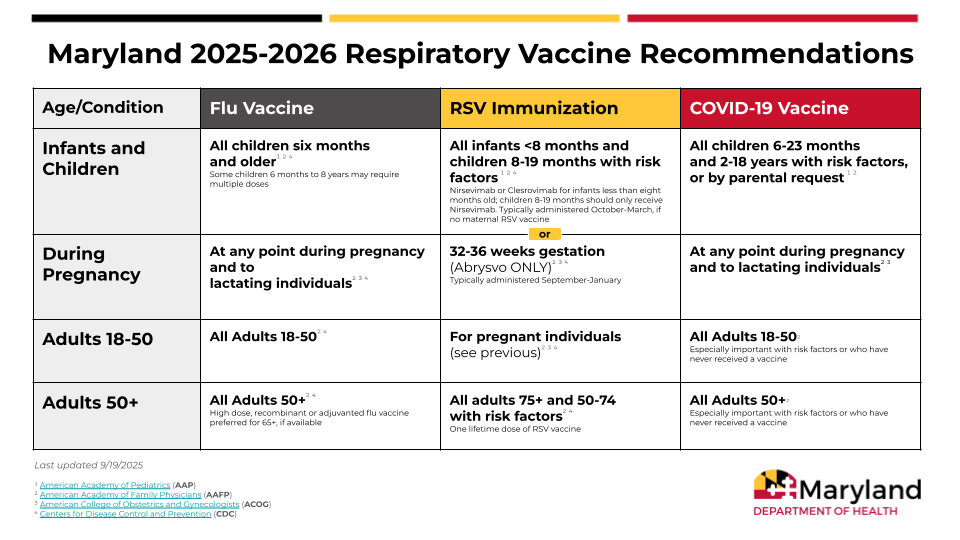
In St. Mary’s County, COVID-19 vaccines are available through various healthcare providers and pharmacies. Maryland pharmacists are authorized to vaccinate children aged 3 years and older. Please check with your pharmacy or healthcare provider to see if they carry/administer the vaccine.
Current Maryland law requires regulated health insurers to cover the COVID-19 vaccine. Maryland Medicaid currently covers the COVID-19 vaccine. Maryland is unable to regulate self-funded health insurance plans, Medicare, Medicare Advantage, Tricare, or Veterans Administration benefits under federal law. However, America’s Health Insurance Plans recently announced a commitment by health plans to continue covering COVID vaccines at zero cost-sharing through 2026.
Please check with your insurance or healthcare provider for more information about your eligibility and coverage for the COVID-19 vaccine.
Get more answers here to frequently asked questions about COVID-19 vaccines.
Treatment
If you test positive for COVID-19 and are more likely to get significant illness from infection, treatments are available that can reduce your chances of being hospitalized, dying from the illness, and developing post-COVID conditions. If you are sick with COVID-19, call your doctor to ask about treatment options, even if your symptoms are mild right now. Don’t delay – treatment must be started within days of when you first develop symptoms to be effective.
SMCHD’s School-Based Health Centers at Margaret Brent and Spring Ridge Middle Schools are available Monday–Friday during school hours for students and staff at any St. Mary’s County school, and after school and during school breaks for all community members. Call (240) 434-6060 to schedule an appointment at the Margaret Brent School-Based Health Center and (240) 434-6059 to schedule an appointment at the Spring Ridge School-Based Health Center.
Post-COVID Conditions
Although most people with COVID-19 get better within days of illness, some people experience post-COVID conditions. Post-COVID conditions are a wide range of new, returning, or ongoing health problems people can experience four or more weeks after first being infected with the virus that causes COVID-19. Even people who did not have COVID-19 symptoms during their infection may develop post-COVID conditions. These conditions can present as different types of health problems for different lengths of time. Post-COVID conditions may also be known as long COVID, long-haul COVID, post-acute COVID-19, long-term effects of COVID, or chronic COVID. Experts around the world are working to learn more about the short- and long-term health effects associated with COVID-19, who gets them, and why. If you are concerned that you may have a post-COVID condition, talk to your personal doctor for evaluation and treatment options.
Connect With Us
General Office Hours:
Mon – Fri: 8:00 am – 5:00 pm
Vital Records Processing Hours:
Mon – Fri: 8:30 am – 4:00 pm
Environmental Health Hours:
Mon & Thurs: 7:00 am – 2:00 pm
Tues, Wed, & Fri: 7:00 am – 4:30 pm

News & Updates
Enter your email to subscribe to the SMCHD newsletter and receive notifications of new health-related information.